This article has been written for SaaS product leaders involved in the go-to-market strategy and product-marketing initiatives. It is designed to give you what you need to build your SaaS positioning strategy framework end-to-end.
It covers four frameworks that work together: your value proposition, your positioning framework, your storytelling framework and your messaging framework. It then covers how to make your differentiators visible, how to get the rest of the business to adopt the position, and how to measure whether any of it worked.
Positioning work sits in the Ideate stage of the ARISE™ GTM Methodology, where we get creative on a foundation of evidence gathered during Research. That order matters. Ideation without research is guesswork.
Remember: good positioning buys space in your buyer's mind. Bad positioning creates confusion and hesitancy.
What is positioning?
Positioning is deliberately defining how you want your company and product to be perceived by target customers relative to the alternatives. It is about carving out a space in the customer's mind that makes your offering the obvious choice for a specific set of needs.
Effective positioning answers four questions:
- Who is your target customer?
- What category are you competing in?
- What unique value do you provide?
- Why should anyone believe you?
If your team gives four different answers to those questions, you do not have a positioning problem in marketing. You have a positioning problem in the business.
Why positioning is critical for SaaS
Positioning matters everywhere, but SaaS makes it unusually load-bearing.
Barriers to entry are low, so new products emerge constantly, and category noise is permanent. The products themselves are often complex, solving layered problems that need simplifying before a buyer will engage. Buying cycles in B2B are long and involve committees, so your position has to survive being retold by a champion to people who never met you. And because the model is subscription-based, the value has to be reinforced continually, or churn does the arguing for you.
Every one of those pressures is a communication problem before it is a product problem.
Define your Value Proposition
The first step is to try to validate your value proposition. To do this, we suggest you use the value proposition template from Strategyzer as seen below.
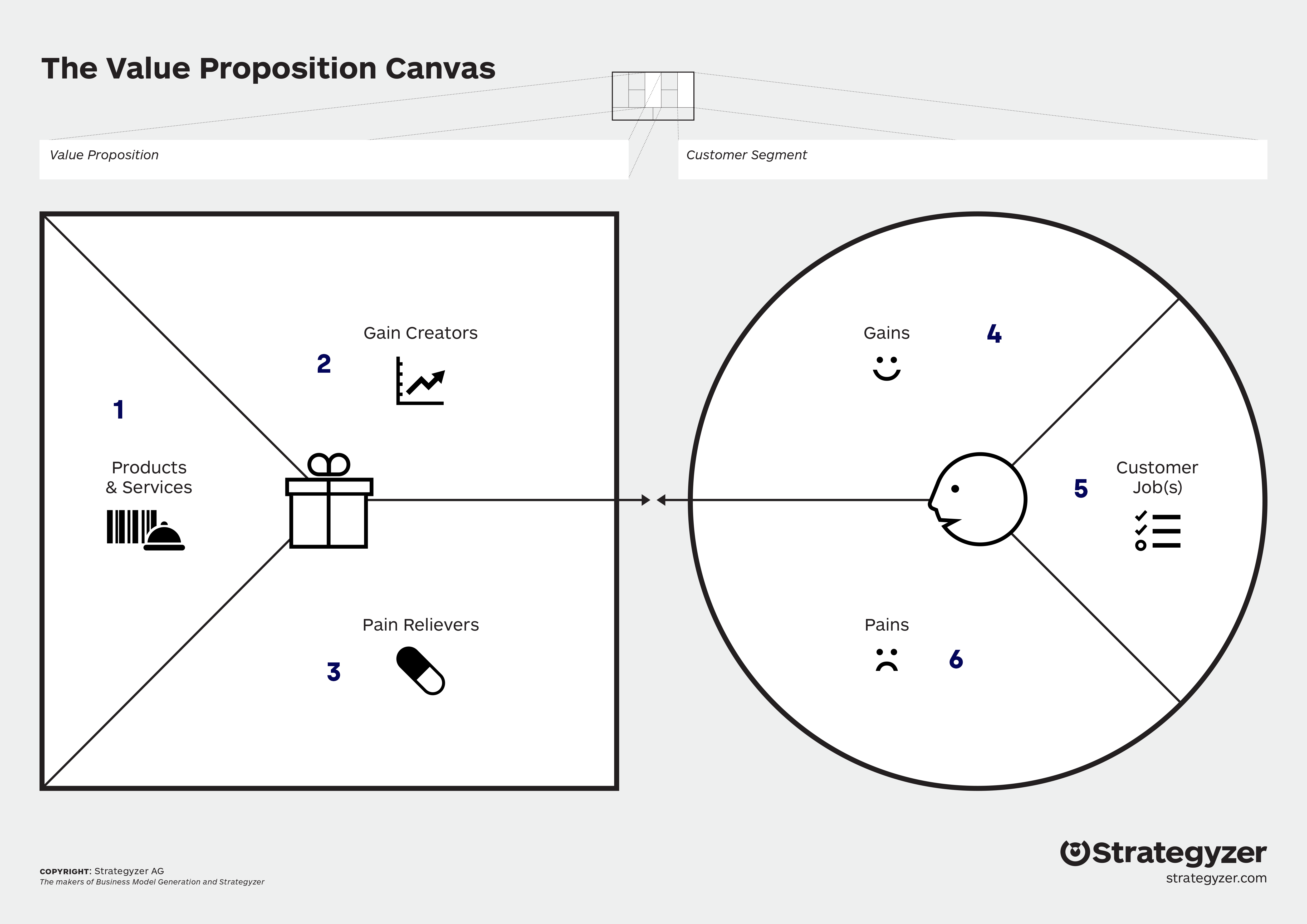
The value proposition canvas helps you map out how your product or service provides value to the potential customer. Note the numbers 1 to 6 added to the canvas, which we use to explain each section. On the left-hand side, you describe your product or service and the gains it creates or the pains it solves.
Value proposition
-
- Products & Services (1): This section identifies the product or service you are offering to your prospective customers.
- Gain Creators (2): In this section, please list the benefits your product or service offers your ideal customers.
- Pain Relievers (3): In this section, list the pain relievers that product or service offers potential customers.
On the right-hand side of the canvas, you discuss the product from the perception of your customer segment or persona.
Customer segment
-
- Gains (4): List how your product or service provides gains for this customer segment.
- Customer jobs (5): List everything your potential customers must do to feel the gains and relieve their pains.
- Pains (6): List your customer segment's pain points.
To best use the canvas, print it out on A0 (UK) paper or 841mm x 1189mm or 33.1in x 46.8in and pin it to the wall or draw it on a large whiteboard. Use sticky notes to complete the sections and photograph each outcome for the record. The moving matters. Positioning arguments get resolved by rearranging, not by discussing.
Session tip
Start your session on the Customer Segment side, working sections 5 and 4, then finishing on 6. Then move across and complete section 1, and either 2 or 3 depending on whether you intend to position on pains solved or gains created. Teams that start on the left-hand side almost always end up describing features and calling it value.
Characteristics of a great value proposition
As a rule of thumb, there are ten characteristics of a great value proposition. These are:
-
- It is embedded in a viable business model rather than bolted onto one.
- It focuses on a few pain relievers or gain creators and does those extremely well.
- It targets jobs, pains or gains that either a large number of customers share or a small number will pay significantly to resolve.
- It aligns with how customers measure success.
- It concentrates on the most significant jobs, the most severe pains and the most relevant gains.
- It differentiates from the competition in a meaningful way.
- It addresses functional, emotional and social jobs together.
- It outperforms the alternatives substantially on at least one dimension.
- It is difficult to copy.
- And it focuses on jobs, pains and gains that remain unsatisfied by what is already on the market.
Test your draft against that list before going further. Anything failing three or more of those tests will not survive contact with a competitive deal. If you want to go deeper on this stage alone, we cover it in detail in how to create a value proposition.
Now that you have established your value to the marketplace, you need a positioning framework that can be measured and improved over time.
"Great positioning makes your strengths obvious. It provides context and a frame of reference, making it easy for customers to understand why they should care about what you do."
April Dunford, Positioning Maestro
Build a positioning framework
We assume you have already worked out your customer segment or persona. If you haven't, do that first, because everything below depends on it.
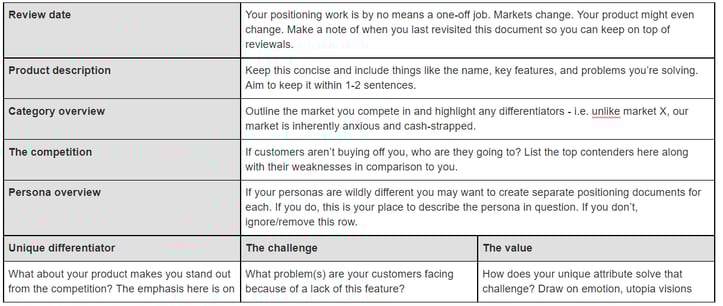
Firstly, agree the review date. Before you start, set a date on which the document will be reviewed, as your product, markets or customer base may change over time. The fastest way to end up with confidently wrong positioning is to write it once and treat it as settled.
Next, write your product description. Keep it concise and include the name, key features and the problems you solve. Aim for one or two sentences. If it takes more, the positioning is not finished.
Then describe your category. Think of it as an overview of your product marketplace. Outline the market you compete in and highlight any differentiators, for example: unlike market X, our market is inherently anxious and cash-strapped. Category context shapes how every claim you make will be received.
Following your category overview, describe the competition. If customers aren't buying from you, who are they going to? List the top contenders along with their weaknesses relative to you. Include the do-nothing option and the spreadsheet, because in B2B they win more deals than most named vendors.
Once you have completed the above, describe your persona. If your personas differ wildly, create separate positioning documents for each rather than one document that hedges across all of them. Hedged positioning reads as vague to everybody.
The differentiator table
To complete the framework, define three more pieces of information. Create a spreadsheet with three columns titled unique differentiator, the challenge, and the value. Then answer the following:
-
- Unique Differentiator: What about your product makes you stand out? The emphasis is on uniqueness. If your competitor offers the same thing, it doesn't belong here.
- The Challenge: What problems are your customers facing because of a lack of this feature?
- The Value: How does your unique attribute solve that challenge? Draw on emotion, on the improved end state, and on real customer quotes where possible.
List as many unique features as possible and answer the challenge and value questions for each. Do this periodically, and you will always be able to position your platform to its target audience.
Be honest in column one. Most tables are ruined by entries every competitor could also claim. Cut anything you cannot defend in a live deal. A maintained differentiator table is the single most useful positioning artefact a revenue team can have, because it is the raw material for sales conversations, web copy, campaign angles and objection handling all at once.
Plan your position statement
There is a standard template, useful mainly for organising thought:
For [target customer] who [need], [product] is a [category] that [key benefit]. Unlike [alternatives], [product] [key differentiator].
It is a starting point rather than an output. A fuller statement is built from six components, and remember your business may need more than one.
- Competitive alternatives - what customers would do if your solution didn't exist
- Unique attributes - the features and capabilities that you have the alternatives lack.
- Value and proof - the benefits that those features enable for customers
- Target market characteristics - the characteristics of a group of buyers that really care a lot about the value you deliver
- Market category - the market you describe yourself as being part of so that customers understand your value proposition
- Relevant trends - trends that your customers understand and/or are interested in that can help make your product more relevant right now
Our advice is to note this, complete the activities throughout this article, and return with a clearer perspective. Both the storytelling and messaging work below will sharpen your view of what belongs in the statement.
Next, design your storytelling framework. SaaS companies build long-term foundations around product positioning by combining a positioning statement with a story.
Design your storytelling framework
Your storytelling framework has twelve key components. Done right, they inspire action, make you more memorable, unite your audience and simplify complex concepts.
But before you put pen to paper, answer this question:
What are you trying to achieve?
Keep the answer top of mind as you complete the steps below. The customer is the hero throughout. Your product is the guide.
The twelve steps to a successful storytelling framework
Step 1: Who is your audience? Write an overview of your market or persona.
Step 2: Where are they now? Describe what their life looks like without your solution.
Step 3: The villain? Their current workaround. How are they trying to resolve the problem today?
Step 4: The disruption? What issues is the villain causing them?
Step 5: Which other characters are involved? Does your audience's problem impact anyone else?
Step 6: How does it impact others? How are these other characters affected?
Step 7: The fairytale ending? What are your audience's goals, and what are they looking for in a vendor?
Step 8: The antagonist? Who is getting in the way of their fairytale ending? In B2B, this might be the blocker or gatekeeper stakeholder. In B2C it could be cost.
Step 9: The hero? How does your solution replace the villain and appease the antagonist?
Step 10: What life could look like? Paint the picture of how much better life with your solution could be. What are the benefits, and how will they make them feel?
Step 11: The moral? What lessons can be learned from your customer’s journey?
Step 12: The new norm? End your story with real words from real customers.
For best results, create a spreadsheet with the questions in bold in column A, the outline questions in column B, and your draft copy in column C. It keeps the story editable and stops it calcifying into a deck nobody updates.
So far so good. If you are still with us, you are putting in the effort to find the right position and story for your SaaS platform. Now you need an effective messaging framework to capitalise on the work so far.
For best results, create a spreadsheet with the questions in bold in column A, the italicised outline questions in column B, and your Kickstarter copy in column C. For an example, see the image below.

Build your messaging framework
Building your successful messaging framework is easy enough if you follow these key steps. This is where positioning becomes usable by everyone else in the business.
Value proposition
Your core value prop often appears in homepage headlines and is a clear, succinct statement of the unique value you offer customers. It should be closely tied to your positioning and have one clear focal point. Around 10 to 15 words.
Audience
Write a brief background on the profile of the persona you're targeting. Note the emphasis on brief. Consider their personality, responsibilities, title and role in the buying process. Remember, this is a person, not a company or group.
Elevator pitch
Write one or two sentences that incorporate your value proposition.
What do you bring to the table that others don't?
Make sure it is unique, captures emotion, and delivers your top one or two value points. If possible, squeeze in a word or two about who your target market is.
Long description
No longer than 100 to 200 words. Include the value points uncovered in your positioning work, as well as:
- Product and feature details, and headline benefits
- An indication of your target market
- Proof points, such as names of current customers or anything brag-worthy like awards, usage or satisfaction stats
Tip #1: Keep It Super Simple. Avoid industry jargon and express your pitch as simply as possible.
Tip #2: Run your pitch through the Readability or Hemingway apps to ensure it is easily understood.
Tip #3: Focus on what you want the recipient to remember afterwards, in terms of both the outcome and the feeling.
Tone of voice
Is it formal, conversational, punchy, or friendly? Your persona research should uncover this. Include three or four adjectives that describe your ideal voice, plus before-and-after examples of what that voice sounds like, so the whole team can hear the difference rather than guess at it.
Outcomes
What outcomes are possible because of your product or solution? List them as simple, concise points. Short, concrete, no hedging.
Customer requirements
What one or two things are crucial to your persona in order to convert? Keep this short and specific.
Outcome pillars
Your elevator pitch and positioning work should be substantiated by pillars of one to three words each. Under every pillar, document four things:
- Pain points: what problems does this value pillar solve?
- Product and feature benefits: how well does your product resolve those pain points? Stick to three to five points focused on value and supporting benefits.
- Product and feature details: which parts of your product are responsible for those benefits, and how do they make you unique? These should align with the points above.
- Proof points: back up what you're saying with a real case study snapshot. For example, "Within eight weeks of onboarding, John from Pretend PLC saved 10+ hours a month and increased his MRR by 11%." If your personas have different pain points and requirements, they need different proof points.
Objection handling
Prepare responses to the objections that recur. Every unanswered objection is a deal that stalls quietly rather than closing or dying cleanly.
Make your differentiators visible
You now have the substance. What remains is making the differentiators obvious to a buyer giving you thirty seconds.
Lead with outcomes rather than features. Avoid vanilla positioning, which is the natural gravitational pull of every product team. Where a differentiator is technical, translate it into what becomes possible.
Use testimonials and case studies as the bridge between what you claim and what buyers can verify. They provide social proof, and more usefully, they let a prospect recognise their own situation in someone else's before-state. Quantify wherever you can: efficiency gained, cost removed, revenue added.
Keep the competitive analysis live rather than annual. It tells you where the gaps are, what customers are being promised elsewhere, and which of your claims are becoming table stakes. Positioning erodes because competitors copy, not because you stopped caring.
Then use content to test all of it. Articles, whitepapers, webinars and social posts are a low-cost way of finding out which angles resonate before you commit them to the homepage. Engagement data tells you which parts of your positioning are landing, and direct responses tell you what you missed.
Align your organisation
Positioning that lives in marketing is not positioning. It is a document.
It has to be reflected in product, sales, marketing and customer support alike. Write the internal documentation, run the training, then test it the only way that matters: ask people across the business what the company offers and to whom. If you get materially different answers, the positioning has not been adopted, regardless of how good the framework is.
Misalignment is expensive in a specific and measurable way. Inconsistent messaging confuses buyers, confused buyers take longer to decide or don't decide at all, and the cost shows up in acquisition cost and churn rather than in a marketing report.
How to measure whether your positioning is working
Positioning is not a one-time exercise. Gather customer feedback regularly, watch competitive moves, test messaging variants, and be prepared to evolve as the product and market change.
These are the metrics that tell you whether the position is doing its job.
| Category | Metric | What it tells you about positioning |
|---|---|---|
| Acquisition | Customer acquisition cost | Total sales and marketing cost divided by new customers. Rising CAC against stable spend usually signals a positioning problem before it signals a channel problem. |
| Acquisition | Conversion rate | Conversions divided by total visitors. Measures whether your differentiators are persuading, not just attracting. |
| Engagement | DAU/MAU | Whether the value you positioned on is being experienced repeatedly. |
| Engagement | Feature usage | Which differentiators customers actually use, as opposed to which ones you lead with. |
| Engagement | Time to value | How quickly a new user reaches the outcome you promised. Long TTV usually means you positioned on the wrong outcome. |
| Retention | Churn rate | Customers lost over customers at period start. Sustained churn against good acquisition points to a promise the product cannot keep. |
| Retention | Customer lifetime value | Whether the value you claim compounds over the relationship. |
| Satisfaction | Net promoter score | Promoters minus detractors. Advocacy is positioning working through other people's mouths. |
| Satisfaction | CSAT | Satisfied responses over total responses. A direct read on expectation versus experience. |
| Revenue | Monthly recurring revenue | The compound result of acquisition and retention working together. |
| Revenue | Expansion revenue | Whether your differentiators create enough value to justify buying more. Often the earliest honest signal that positioning is right. |
Watch the relationships between these rather than the numbers individually. High acquisition with high churn means the positioning is selling something the product isn't. Low acquisition with high retention and strong NPS usually means the positioning is too narrow or too quiet, which is a far better problem to have.
Where positioning sits in ARISE
Positioning belongs to the Ideate stage of the ARISE™ GTM Methodology, and it depends entirely on what came before it. Assess establishes what you actually know as opposed to what you assume. Research replaces assumption with evidence through win-loss interviews, customer interviews and competitive analysis. Only then does Ideate have anything worth working with.
What comes out of this stage, the value proposition, the positioning framework, the story and the messaging, then feeds Strategise, where it becomes a pricing model, a channel mix and a defined GTM motion, and Execute, where it becomes campaigns, sales conversations and a website.
The real problem for fast-growing SaaS organisations is that teams change at speed and the process suffers as a result. It is irresponsible to discard process or measurement capability in the name of growth and promise to fix it later. We live in a world of data-driven decision-making, so why object to a complete positioning strategy when it directly affects the bottom line and the firm's ability to generate revenue?
Great positioning makes your product's value obvious to the people you want as customers. It simplifies their decision and clarifies why you are the right choice. Everything above is in service of that one outcome.
If your team needs assistance with positioning and messaging, speak to us. Our ARISE™ GTM Methodology builds on this work to ensure your entire go-to-market strategy is fit for purpose and creates a solid foundation for growth. We also run a one-day positioning workshop that works through the value proposition canvas, the differentiator table and the messaging framework with your team in the room.